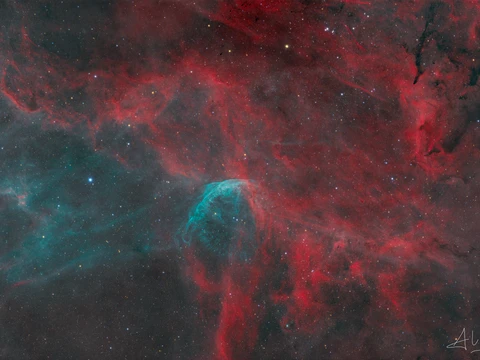
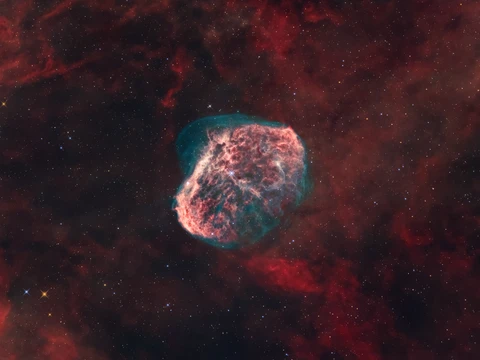
Wolf-Rayet stars (WRs), identified in 1867 by astronomers Charles Wolf and Georges Rayet, represent the advanced evolutionary stage of objects with masses ranging from 5 to over 20 solar masses. Characterized by high surface temperatures, they emit radiation primarily in the ultraviolet range. Following the depletion of hydrogen in the core, nuclear fusion continues towards heavier elements such as helium and carbon. The high radiative flux triggers stellar winds with speeds of thousands of kilometers per second, resulting in intense mass loss that fuels the formation of circumstellar nebulae of gas and dust.Le stelle di Wolf-Rayet (WR), identificate nel 1867 dagli astronomi Charles Wolf e Georges Rayet, rappresentano la fase evolutiva avanzata di oggetti con masse comprese tra 5 e oltre 20 masse solari. Caratterizzate da elevate temperature superficiali, emettono radiazione prevalentemente nella banda ultravioletta. In seguito all'esaurimento dell'idrogeno nel nucleo, la fusione nucleare prosegue verso elementi più pesanti come elio e carbonio. L'elevato flusso radiativo innesca venti stellari con velocità di migliaia di chilometri al secondo, determinando un'intensa perdita di massa che alimenta la formazione di nebulose circumstellari di gas e polveri.